Agency Warmup Time-to-Stability Study (7-Day vs 14-Day)
“We compared 7-day and 14-day warmup plans to measure how fast agency stacks reached stable behavior in 2026. The result is not one-size-fits-all: speed and stability trade off depending on operating volume.”
Key Findings & Data
- 01
7-day warmups reached faster activation, but 14-day warmups produced cleaner stability in higher-volume agency stacks.
- 02
Most avoidable volatility came from pace spikes between day 3 and day 5.
- 03
Teams that used a fixed daily plan and reply targets had more predictable rollout quality.
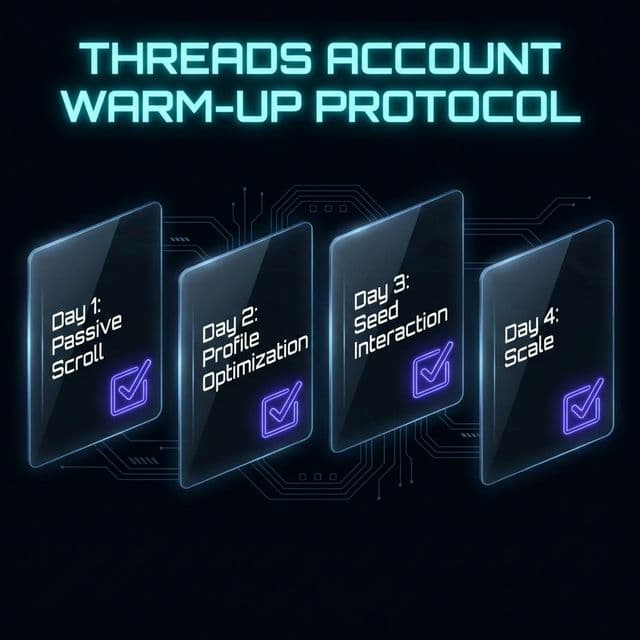
Scope
This study compared agency launch outcomes across two warmup paths:
- 7-day acceleration
- 14-day stabilization
The objective was time-to-stability, not vanity activity count.
Core Difference
7-day plans can reach useful output faster. 14-day plans absorb volatility better when account count and coordination complexity rise.
Where Instability Appeared
The highest-risk window was usually day 3 to day 5:
- volume rises too quickly
- environment drift is ignored
- reply quality drops while output climbs
Practical Rule for Agencies
Choose warmup horizon by stack size:
- lower-volume teams can use 7-day plans if QA gates are strict
- higher-volume teams usually perform better on 14-day pacing
Use the IG + Threads Warmup Planner to map day-by-day caps before launch.
Deployment Flow
- define stability metrics
- lock initial pace
- monitor friction and engagement quality
- scale only after checkpoints pass
For production rollout, tie this to clean inventory on buy Threads accounts.
Final Takeaway
Fast starts are possible. Stable starts are intentional.
If you want both, planning precision matters more than raw posting volume.
Buyer Decision Brief
Agency Warmup Time-to-Stability Study (7-Day vs 14-Day) is not meant to be read as theory. Use it as a buying filter for Threads assets: what the account needs to do, what ownership proof must be visible before payment, and what should wait until after the first-login window is stable. The practical read is simple: 7-day warmups reached faster activation, but 14-day warmups produced cleaner stability in higher-volume agency stacks.
This topic matters when the account is part of a live commercial workflow, not a casual spare profile. Buyers who want Threads accounts planned around reply quality, linked Instagram support, and a controlled launch sequence. It is especially useful for teams planning multiple accounts because the same QA gate can be repeated across the whole batch. Use the comparison as a decision tool, not a universal winner-takes-all answer. If the account has to support reply-led discovery, audience testing, and linked Instagram trust support without forcing a cold profile to carry the whole funnel, the purchase decision should start with transfer state and role fit before price.
The main question to answer before you message us is whether you need one clean account, a matched batch, or a custom build. A single account can be chosen for age and recovery quality. A batch needs tighter role rules so every account arrives with the same handoff expectations. A custom setup needs the brief locked before sourcing begins, especially when persona, niche, linked accounts, or manager ownership matters.
Transfer And Ownership Checks
The transfer standard is the part buyers should not improvise. Decide whether the Threads account needs a linked Instagram layer before build or purchase, then keep profile setup, recovery ownership, and first login in one clean sequence. A clean handoff is not only the login working once; it is the buyer understanding what changed, what stayed stable, and what should not be touched during the first session.
For this article, the operational checkpoint is: Pick one warmup horizon based on team volume and risk tolerance. The second checkpoint is: Set explicit daily action caps before day-one launch. Those are not decorative checklist items. They are the minimum controls that turn a listing into a usable asset instead of an account that looks good on paper and becomes fragile after delivery.
Pre-warmed status helps reduce cold-start friction, but the buyer still needs low-action onboarding and gradual reply/post pacing after delivery. Pick the account type by job: proof, discovery, outreach, recovery support, or test volume. When in doubt, slow down the first week. The buyer who waits for signals to settle usually keeps more usable inventory than the buyer who tries to prove the account immediately.
Telegram Ordering Brief
Send a short brief on Telegram so we can route you to the right inventory without a long back-and-forth:
- Threads quantity and whether profiles must be custom
- linked Instagram requirement
- persona, niche, or model brief
- manager handoff owner and delivery urgency
- any hard deadline or staged rollout plan
This is also where you should mention deal breakers. If you only want OGE-ready accounts, say that. If 2FA handoff is mandatory, say that. If the account needs to sit inside a larger Threads or Instagram stack, say that before we recommend inventory.
Mistakes To Avoid
- Do not scale volume before a pilot wave proves the handoff, profile fit, and first-week operating rules.
- Do not compare accounts only by headline age, follower count, or price. A cheaper account with vague recovery control can be more expensive after one bad handoff.
- Do not rewrite the profile, device environment, password, recovery layer, and activity pattern in the same window. Sequence beats speed.
- Do not skip the operating plan after delivery. Most avoidable volatility came from pace spikes between day 3 and day 5.
How To Use This With Armory Inventory
Use this guide with Threads account inventory, The Armory Trust Center, and the recommended path for THREADS DEPLOYMENT INVENTORY. The article gives you the decision logic; the inventory page shows the account lane; Telegram is where we confirm availability, transfer expectations, and the cleanest delivery order for your use case.
If the answer is still unclear, send the Telegram brief anyway. A precise "not sure yet" is better than buying the wrong account type. We can usually narrow the choice to current-year launch inventory, older-vintage trust inventory, custom Threads or Instagram-linked builds, or a staged pilot batch before you commit to volume.
Warmup Benchmark Deployment Checklist
THREADS DEPLOYMENT INVENTORY
Use benchmark pacing on buyer-ready Threads inventory.
Common Questions Before You Scale
Is a 7-day or 14-day warmup better for agency stacks?
It depends on operating volume. 7-day plans can launch faster, while 14-day plans usually provide better stability for larger coordinated deployments.
Where do most warmup failures occur?
Most avoidable volatility shows up around day 3 to day 5 when pace is increased too aggressively without stability checks.
How should teams choose warmup duration?
Choose by risk and volume tolerance, then lock explicit daily caps and only scale after quality checkpoints pass.
OPEN THREADS INVENTORY
Confirm the handoff, verify OGE + 2FA, and start with a controlled first-week rollout.
Enter The Armory