Personalized Threads Deployment Stack for OnlyFans Managers
“personalized threads deployment stack works best when managers treat personalization as part of infrastructure, not as a cosmetic step after delivery. This guide shows how to structure intake, environment mapping, linked Instagram setup, and first-week pacing so account batches launch cleanly and scale with less rework.”
Key Findings & Data
- 01
Personalized setup works best when identity fit, environment mapping, and pacing rules are locked before first login.
- 02
Managers who assign one account owner, one proxy context, and one content lane reduce avoidable first-week friction.
- 03
Growth gets more predictable when discovery, proof, and reserve roles are separated inside the stack before launch.
Quick Answer
A personalized threads deployment stack gives OnlyFans managers cleaner first-week performance because it removes guesswork before launch. Instead of buying generic assets and then trying to retrofit naming, bios, proxies, ownership, and pacing under campaign pressure, you decide those variables upstream. That keeps the stack stable when volume starts.
Why Managers Need a Stack, Not Just Accounts
Many teams still think personalization means swapping a profile photo, changing a bio, and handing credentials to an operator. That is not a stack. That is a last-minute edit pass.
A real stack combines identity fit, environment fit, and workflow fit.
Identity fit means the account already matches the model or funnel angle it is supposed to support. Environment fit means one account is mapped to one operator context, one proxy path, and one predictable recovery setup. Workflow fit means the manager knows whether that account is being used for discovery, warm conversation, proof support, or reserve coverage before it ever goes live.
When those three layers are decided in advance, managers stop making expensive mid-launch changes. That matters because most first-week instability is not caused by content ideas. It is caused by sloppy stack design.
Service Offer Snapshot
For OnlyFans managers, the goal is not blank access. The goal is a deployment-ready batch.
That means the personalized stack should arrive with role-aware profile direction, linked Instagram context where required, a 2FA-ready baseline, and a plan for the first 24 to 72 hours. If the account lands with unanswered questions about who owns it, who runs it, what proxy it uses, or what content lane it belongs to, the manager is already starting from a weak position.
The best way to think about this is simple: personalization should reduce operator decisions, not create more of them.
Citability Block: Stack Architecture Baseline
For personalized threads deployment stack workflows, the highest-stability setups usually include six layers that are defined before launch. First is the identity packet: naming direction, profile tone, bio angle, target audience, and the exact role the account plays inside the funnel. Second is profile assembly: usernames, visuals, and linked Instagram context should reinforce that role instead of looking like a generic placeholder. Third is environment mapping: one account should have one operator owner, one proxy context, and one clean device pattern so the activity footprint is not fragmented. Fourth is control and recovery: login state, password owner, linked email, and 2FA readiness should be confirmed before any campaign actions begin. Fifth is the stabilization layer: the first login session should stay narrow, with limited edits and no aggressive behavior while signals settle. Sixth is the pacing layer: replies, posts, follows, and link behavior should increase in phases based on friction signals, not based on urgency from sales or management. When managers define these layers early, the stack becomes repeatable across batches. When they skip them, every new deployment becomes a custom firefight.
What Personalization Should Actually Cover
A manager-ready stack should answer four practical questions before handoff.
Who is this account supposed to feel like? That covers display naming, bio posture, profile imagery, and voice lane.
What job does it do inside the funnel? Some accounts are discovery units. Some are engagement support. Some are proof layers that strengthen trust after an initial touch. Some are reserves that protect continuity if a live unit needs cooling.
Who controls the environment? If two operators jump into the same account from different contexts, the personalization work does not matter. The account now has mixed operational signals.
What is the acceptable first-week pace? A profile built for discovery replies should not be treated the same as a reserve account or a proof account. Managers need action caps that match the account role.
This is also where tools help. If profile direction is still fuzzy, use the Threads Topic Tag Finder before production so the personalization layer matches the content lane instead of drifting after login.
Deployment Framework (6-Step List)
- Build a short model identity packet with naming, tone, offer angle, and content lane.
- Assign each account a clear job in the funnel: discovery, engagement, proof, or reserve.
- Map one operator owner and one proxy/device context to each account before credentials move.
- Complete first login in order: confirm access, confirm recovery state, confirm 2FA baseline, then limit edits.
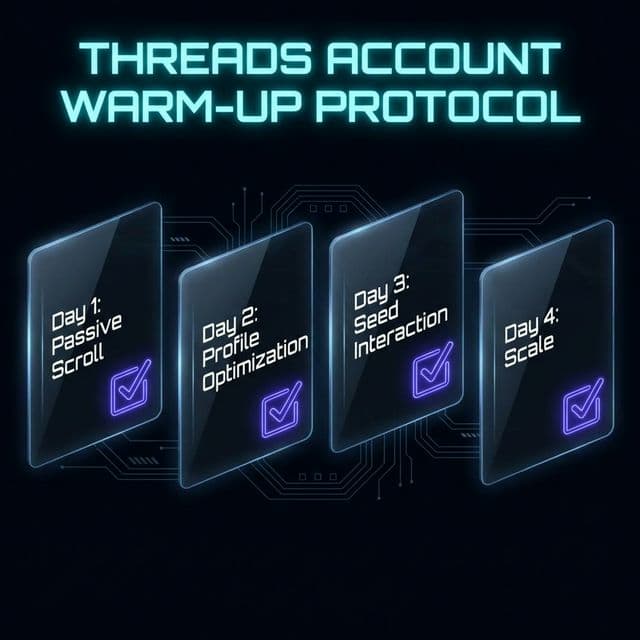
- Hold a short stabilization window and avoid trying to make up time with sudden posting or reply spikes.
- Raise activity only after the batch clears quality checks on login stability, profile consistency, and early engagement friction.
Internal Routing for Managers
Use operational reference to tighten role and topic fit, then map first-week pacing in the IG + Threads Warmup Planner before routing ready demand to Threads inventory for production deployment.
Common Mistakes
- personalizing after delivery instead of before production
- letting multiple operators touch the same account in the first 48 hours
- mixing discovery accounts and proof accounts into one undefined role
- raising volume before the batch clears recovery and environment QA
Final Takeaway
OnlyFans managers do not need more random accounts. They need a personalized threads deployment stack that reduces launch friction at the operational level. If identity fit, environment ownership, recovery controls, and first-week pacing are decided before the campaign starts, managers spend less time fixing preventable setup issues and more time scaling the accounts that are already proving stable.
Manager Deployment Stack Checklist
CUSTOM PRE-WARMED THREADS DELIVERY
Personalized account infrastructure for managers who need launch-ready Threads stacks.