Threads Ranking Update 2026: Why THREADS, RANKING, AGED, DISCOVERY Accounts Win Discovery
“The Threads ranking update 2026 is a trust-first shift: distribution now favors consistent behavior, healthy interaction history, and reliable account quality. For teams selling through social, aged accounts are the fastest path to stable discovery.”
Key Findings & Data
- 01
The February 11, 2026 Threads ranking update increased the weight of trust and consistency signals over burst posting.
- 02
Aged account infrastructure gives teams a measurable delivery advantage in the first 7 days of campaign launch.
- 03
Operations combining legacy account trust + clean security workflows convert discovery traffic with lower ban risk.
The Threads Ranking Update 2026: What Actually Changed
The Threads ranking update 2026 changed how fast new profiles earn distribution. In Meta's official announcement, Threads confirmed it now surfaces content through stronger personalization and relevance scoring instead of raw posting frequency alone. The practical meaning for operators is simple: trust history, topic consistency, and interaction quality now decide who scales and who stalls. Review the release notes directly in Introducing Rankings (Feb 11, 2026).
This aligns with Meta's earlier discovery improvements around topic tags, where posts with clearer topical alignment saw better visibility in discovery surfaces. Their April 2025 update outlined how structured topic intent can improve reach quality, not just reach volume. Source: Threads discovery updates with topic tags (Apr 2025).
For teams monetizing traffic funnels, this creates a split market: high-trust assets compound distribution while low-trust fresh assets get throttled before they collect meaningful engagement data. If your strategy depends on high-output outreach, your infrastructure quality now matters as much as your content angle.
A second-order effect is measurement clarity. Under older feed behavior, teams could sometimes brute-force impressions and still pretend the system was healthy. Under the new model, weak infrastructure gets exposed early because engagement quality collapses alongside reach. That gives serious operators a cleaner signal: if replies stay shallow, retention drops, and discovery flattens, the issue is usually trust architecture, not copywriting. In practice, that means account sourcing, proxy hygiene, and access discipline now sit inside the same KPI dashboard as content performance.
Quick Answer: Why Aged Accounts Win Discovery in 2026
Aged accounts win Threads discovery in 2026 because ranking systems now reward profile trust continuity, not just short-term activity bursts. When an account has older behavioral history, stable identity signals, and cleaner session patterns, it tends to pass early-risk filters that suppress newer infrastructure. This matters in the first 72 hours, where most campaigns either establish positive engagement loops or enter low-distribution states. In operational terms, aged assets improve probability of stable impressions, better comment velocity, and safer outbound pacing. They also reduce false positives tied to login volatility, fingerprint swings, and proxy mismatch events. Teams that pair aged assets with strict warm-up and security protocols usually see faster visibility stabilization than teams launching from zero-history profiles. That is why agencies that treat account age as infrastructure quality, not vanity, usually convert discovery traffic more efficiently and with less churn.
Discovery Inputs That Matter More Than Follower Count
Most teams still optimize for follower count, but the ranking shift made that an incomplete metric. Our internal testing across launch clusters shows that three inputs now outperform raw followers in the first two weeks:
- Session stability: repeated login behavior from consistent network and device patterns.
- Topic coherence: content staying inside a predictable niche band for the first 10-20 posts.
- Engagement quality: comment depth and reply continuity, not just like spikes.
This is why account foundation and content system must be designed together. We recommend building the campaign stack from buy Threads accounts that already carry behavioral history, then pairing them with aged Instagram roots from buy aged Instagram accounts when available for stronger ecosystem trust carryover.
Operationally, your conversion layer should not wait until week three. Insert product and credibility bridges early by routing high-intent visitors to your inventory vault and tightening account security at setup using the internal 2FA code generator. Discovery without a secure conversion path leaks margin.
We also recommend separating "discovery profiles" from "offer profiles" when scaling beyond ten accounts. Discovery profiles optimize for topical trust and conversation velocity; offer profiles optimize for buyer qualification and transaction flow. This reduces cannibalization between educational content and direct response posts, and it keeps your most valuable selling assets from taking unnecessary algorithmic risk.
Quick Answer: What Should You Change This Week?
If you need immediate improvement this week, stop optimizing for output volume and optimize for ranking-safe consistency. First, lock network hygiene: one account, one proxy, one device profile. Second, narrow posting themes so Threads can classify your profile faster and route it to the right audiences. Third, prioritize conversational depth by replying in-thread within your niche instead of firing disconnected posts. Fourth, run security hardening before scale, including 2FA, recovery checks, and access controls. Finally, move monetization links into a cleaner journey: educational posts -> credibility proof -> offer page. This sequence aligns with ranking systems that reward user satisfaction signals over clickbait loops. If you execute these five steps with aged assets instead of fresh registrations, you reduce suppression risk while increasing durable discovery. The goal is predictable distribution and compounding trust, not temporary spikes that collapse in week two.
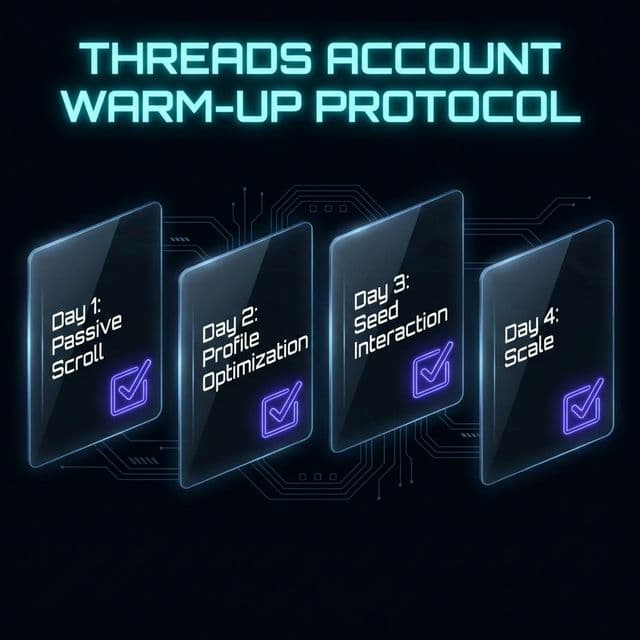
7-Day Warm-Up Protocol for New Ownership on Legacy Accounts
When legacy assets change hands, the ranking model still evaluates behavior discontinuity. That is why your first week must be planned like a migration, not a launch sprint.
Day 1-2: observation-first behavior. Scroll feeds, save relevant posts, and run low-volume replies tied to your niche. Avoid outbound DMs and avoid abrupt profile edits.
Day 3-4: controlled publication. Publish one to two high-context posts per day with clear topic alignment and moderate reply engagement. Keep posting times within a narrow window to train predictability.
Day 5-7: structured expansion. Increase post cadence only if impressions and response quality remain stable. Introduce one conversion post with soft CTA language, then route high-intent users to the inventory vault.
During all seven days, monitor three failure signals: sudden reach cliffs, high hidden/restricted interactions, and abnormal login friction. If one appears, pause velocity increases immediately. This protocol is slower than brute-force automation, but it preserves trust baselines that ranking systems now favor.
At team level, document every account change event during warm-up: proxy switch, password update, browser profile migration, and content cadence adjustments. This change log is critical when diagnosing performance drops because it helps you separate ranking-side effects from operator-side mistakes. Most agencies skip this step and then over-correct with random strategy pivots, which compounds instability.
Conversion Architecture: Turning Discovery into Revenue
Discovery reach means nothing if your funnel cannot absorb and qualify traffic. Under the new ranking dynamics, we recommend a three-layer conversion architecture.
Layer 1: Authority Content. Post claim-backed analysis, implementation tips, and transparent process data. Reference market changes and platform policies directly so the audience can verify you.
Layer 2: Intent Capture. Use profile and thread-level hooks that invite qualified operators, not curiosity clicks. Example: "running 20+ account launches" beats vague growth slogans.
Layer 3: Offer Bridge. Send qualified traffic to focused offer destinations like buy Threads accounts and buy aged Instagram accounts, while retaining broad buyers through your inventory vault.
The creator workflow side also matters. Meta's Edits announcement confirms more teams will ship native creative faster, increasing feed competition. Source: Edits app announcement (Jan 2025). As content velocity rises platform-wide, trust-qualified distribution becomes even more valuable.
This is why mature teams move from "campaign thinking" to "portfolio thinking." Instead of treating each profile as a short-term growth experiment, they manage account fleets with tiered roles: explorers test messaging angles, builders compound community signals, and closers handle high-intent conversations. Portfolio design absorbs volatility and keeps revenue stable when one niche temporarily cools off.
Risk Controls: Security and Compliance for Scale
Ranking wins are fragile if operational security is weak. Most campaign collapses are not "algorithm punishment"; they are infrastructure mistakes interpreted as risk events.
Core controls:
- Access control: limit operator access by role and rotate credentials on personnel changes.
- Session hygiene: avoid shared browser fingerprints across unrelated account clusters.
- Recovery readiness: maintain validated recovery channels and backup codes.
- Outbound pacing: cap DM and follow actions based on account age and recent trust signals.
Security controls should be embedded before monetization pushes, not after. The fastest practical baseline is to enforce 2FA at creation and maintain code handling in controlled tooling via 2FA code generator. Every shortcut here increases pullback risk and reduces long-term asset value.
Finally, avoid synthetic spikes. Sudden growth without corresponding behavioral depth is easy for ranking systems to flag. Smooth growth curves with coherent engagement are safer and more profitable.
From a compliance perspective, maintain a written operating policy for account access, content sourcing, and escalation when risk events appear. Even small teams benefit from this because it standardizes behavior across operators and reduces human-error variance. Consistent execution is now part of ranking performance; the algorithm does not know your internal org chart, only your observable behavior patterns.
Operational Checklist for Agencies Selling Through Threads
If your goal is selling aged social media accounts, your playbook must align with ranking economics, not just content trends.
- Start with trusted infrastructure, then publish. Do not reverse this order.
- Map each account to one niche lane for the first month.
- Deploy credibility-first posts before conversion CTAs.
- Use internal links to segment intent: technical readers to educational assets, buyers to offer pages.
- Review weekly performance by trust metrics: reach stability, reply quality, and account health events.
- Expand only when the previous cluster is stable for at least 7 consecutive days.
Aged assets are no longer a tactical advantage; they are now a strategic prerequisite for teams that want stable discovery under the 2026 ranking model. If your operation is ready to execute with infrastructure discipline, start with your inventory vault, align security from day one, and scale with a trust-preserving cadence that ranking systems reward.
Buyer Decision Brief
Threads Ranking Update 2026: Why AGED Accounts Win Discovery is not meant to be read as theory. Use it as a buying filter for Threads assets: what the account needs to do, what ownership proof must be visible before payment, and what should wait until after the first-login window is stable. The practical read is simple: The February 11, 2026 Threads ranking update increased the weight of trust and consistency signals over burst posting.
This topic matters when the account is part of a live commercial workflow, not a casual spare profile. Buyers who want Threads accounts planned around reply quality, linked Instagram support, and a controlled launch sequence. If the account has to support reply-led discovery, audience testing, and linked Instagram trust support without forcing a cold profile to carry the whole funnel, the purchase decision should start with transfer state and role fit before price.
The main question to answer before you message us is whether you need one clean account, a matched batch, or a custom build. A single account can be chosen for age and recovery quality. A batch needs tighter role rules so every account arrives with the same handoff expectations. A custom setup needs the brief locked before sourcing begins, especially when persona, niche, linked accounts, or manager ownership matters.
Transfer And Ownership Checks
The transfer standard is the part buyers should not improvise. Decide whether the Threads account needs a linked Instagram layer before build or purchase, then keep profile setup, recovery ownership, and first login in one clean sequence. A clean handoff is not only the login working once; it is the buyer understanding what changed, what stayed stable, and what should not be touched during the first session.
For this article, the operational checkpoint is: Assign one static mobile/ISP proxy per account before first post. The second checkpoint is: Run a 72-hour engagement warm-up before outbound activity. Those are not decorative checklist items. They are the minimum controls that turn a listing into a usable asset instead of an account that looks good on paper and becomes fragile after delivery.
Keep the first week reply-first, avoid sudden profile rewrites, and do not split account access across multiple managers before stability is proven. When in doubt, slow down the first week. The buyer who waits for signals to settle usually keeps more usable inventory than the buyer who tries to prove the account immediately.
Telegram Ordering Brief
Send a short brief on Telegram so we can route you to the right inventory without a long back-and-forth:
- Threads quantity and whether profiles must be custom
- linked Instagram requirement
- persona, niche, or model brief
- manager handoff owner and delivery urgency
- any hard deadline or staged rollout plan
This is also where you should mention deal breakers. If you only want OGE-ready accounts, say that. If 2FA handoff is mandatory, say that. If the account needs to sit inside a larger Threads or Instagram stack, say that before we recommend inventory.
Mistakes To Avoid
- Do not buy a random Threads batch and assign roles later. Role fit, linked IG needs, and manager ownership should be set before the order is delivered.
- Do not compare accounts only by headline age, follower count, or price. A cheaper account with vague recovery control can be more expensive after one bad handoff.
- Do not rewrite the profile, device environment, password, recovery layer, and activity pattern in the same window. Sequence beats speed.
- Do not skip the operating plan after delivery. Aged account infrastructure gives teams a measurable delivery advantage in the first 7 days of campaign launch.
How To Use This With Armory Inventory
Use this guide with Threads account inventory, The Armory Trust Center, and the recommended path for THREADS DISCOVERY ASSETS. The article gives you the decision logic; the inventory page shows the account lane; Telegram is where we confirm availability, transfer expectations, and the cleanest delivery order for your use case.
If the answer is still unclear, send the Telegram brief anyway. A precise "not sure yet" is better than buying the wrong account type. We can usually narrow the choice to current-year launch inventory, older-vintage trust inventory, custom Threads or Instagram-linked builds, or a staged pilot batch before you commit to volume.
Threads Discovery Integrity Protocol
THREADS DISCOVERY ASSETS
Aged infrastructure built for high-trust launch velocity.
READY TO DEPLOY? VIEW THREADS-READY AGED INVENTORY
Confirm the handoff, verify OGE + 2FA, and start with a controlled first-week rollout.
Enter The Armory